Structured Notes 101: Customizing Risk and Return
Most investment decisions come down to a simple choice: earn a steady, modest return, or accept more risk in exchange for greater upside. Structured notes are built to blur that line, letting investors define their own trade-off between income, growth, and protection.

Most investment decisions come down to a simple choice: earn a steady, modest return, or accept more risk in exchange for greater upside. Structured notes are built to blur that line, letting investors define their own trade-off between income, growth, and protection.
A structured note combines two simple building blocks.
At its core, a structured note pairs a bond-like component, which is designed to return some or all of an investor's capital, with a component linked to the performance of an underlying reference. That underlying could be a single stock, an equity index, a basket of assets, or even the credit health of a company or government. Combining these two elements allows a much wider range of payoff profiles to be created than a plain bond or a plain equity investment could offer on its own.
The market has grown steadily, even through volatile years.
Structured notes are no longer a niche corner of finance. Industry estimates put the global structured notes market at more than $3 trillion outstanding, a figure that has been rising steadily even through volatile markets. Structured notes were historically the preserve of private banking clients, offered selectively and in large minimum sizes. In recent years, that has changed, with a broader range of investors gaining access to the same types of structures that were once reserved for the largest accounts.
Notes are issued by financial institutions.
Structured notes are typically issued by large, regulated financial institutions, such as global or regional banks, in a similar way to how a bond is issued. Whatever a note is designed to deliver — a coupon, a capped return, or the return of principal — is an obligation of that issuing institution. This means the issuer itself, and not only the specific terms of the note, is a relevant factor to understand alongside a note's other features.
Every feature comes at a cost.
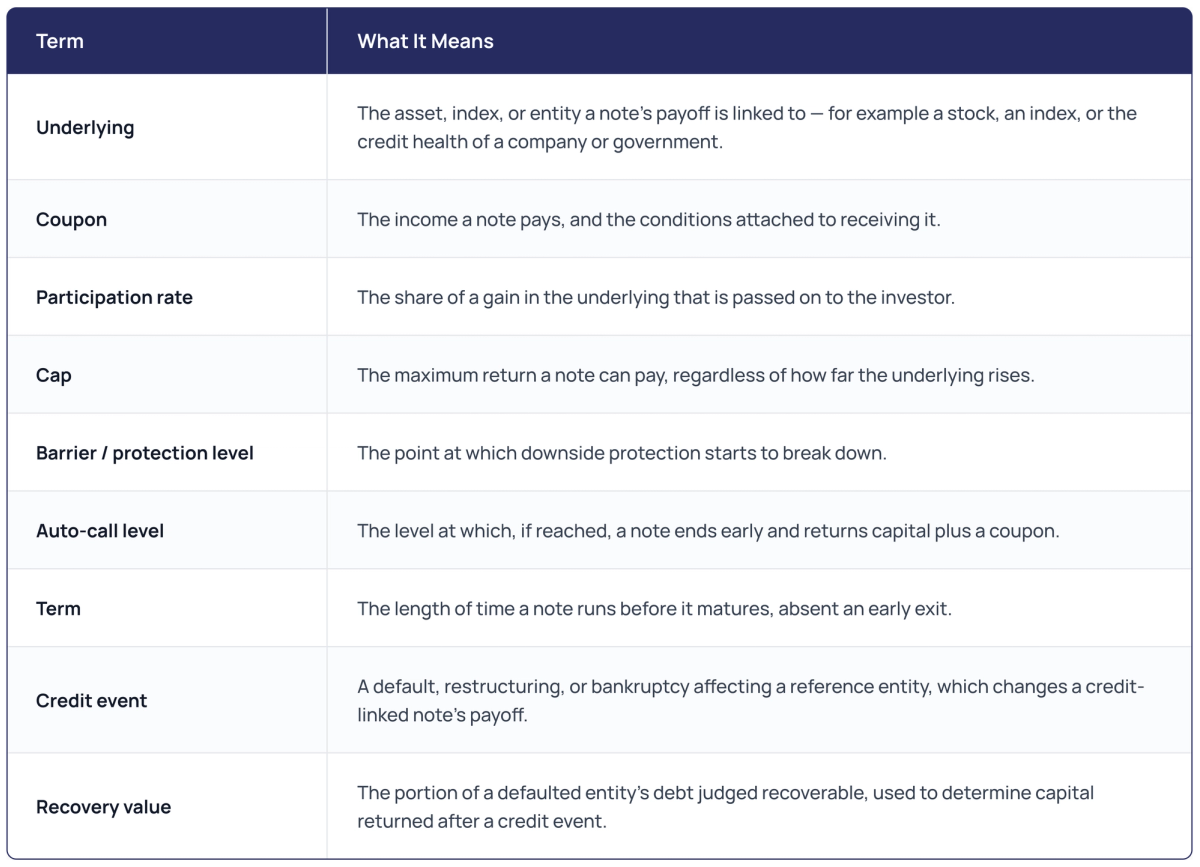
There is no such thing as a free feature in a structured note. A high coupon, a capital protection feature, or an amplified growth rate is always funded by giving something up elsewhere in the structure. The specific trade-off is set by a handful of parameters, which typically include the coupon (the income paid, and the conditions attached to it), the participation rate (how much of a gain in the underlying is passed on to the investor), the cap (the maximum return achievable), the barrier or protection level (the point at which downside protection starts to break down), and the term (how long the note runs before it matures). Reading a structured note means understanding which of these levers has been pulled, and in which direction.
Key terminology
Four common structures each solve a different problem.
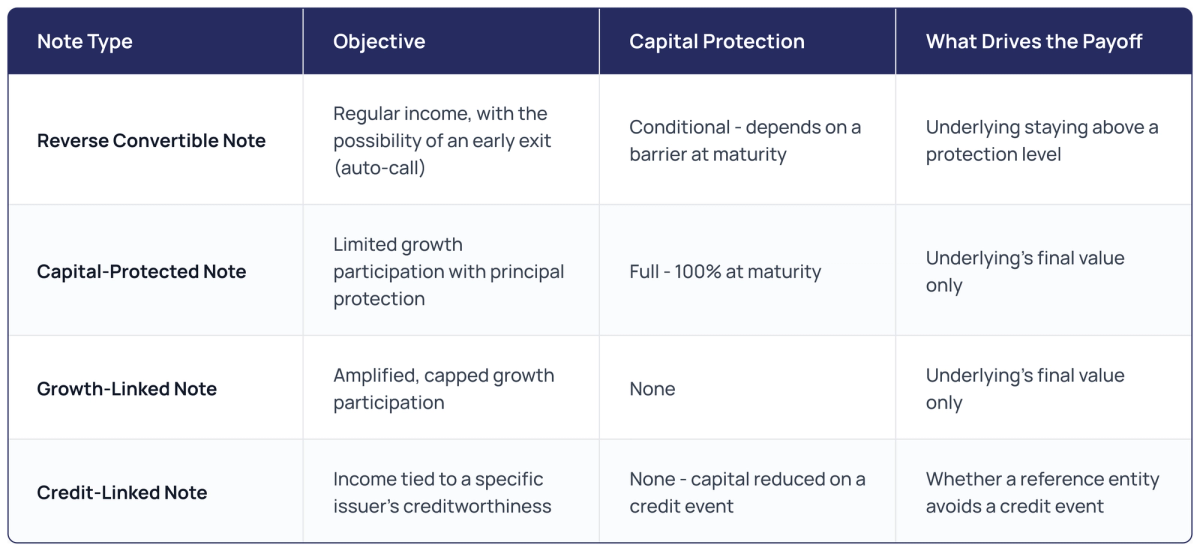
Structured notes are generally built around a small number of well-established designs. Reverse convertible notes are built around income, paying a coupon and the possibility of an early exit. Capital-protected participation notes prioritize the return of principal at maturity, offering limited growth in exchange. Growth-linked notes remove that protection to offer a leveraged, though capped, participation in gains. Credit-linked notes step away from asset prices altogether, tying returns to the financial health of a specific entity instead.
Understanding which trade-off a note is asking an investor to make, and what is being given up in exchange for it, is the essential first step before considering any structured note. The next four articles in this series look at each of these structures in turn.
Note types at a glance